








How Are Motorcycle Accidents Treated Differently Than Car Accidents in Florida?
A motorcycle accident can change your life in an instant. Beyond the physical pain of serious injuries, injured riders face weeks or months of medical appointments, mounting medical expenses, lost income, and the emotional weight of a slow recovery. At the same time, insurance companies are working behind the scenes to minimize what they pay you. It is a lot to manage while you are trying to heal.
What many riders do not realize until after a crash is that motorcycle accident cases are handled very differently from car accident cases under Florida law. The insurance rules are different. Law enforcement documentation is different. And the biases that injured riders face from insurance adjusters are real and significant. Understanding these differences is the first step toward protecting your rights and pursuing the compensation you deserve. Working with an experienced motorcycle accident lawyer gives you the best chance of navigating this complex process successfully.
At Fran Haasch Law Group Car Accident & Personal Injury Lawyers, we have extensive experience handling Florida motorcycle accident cases. We know the tactics insurance companies use to undervalue motorcycle accident claims, and we are ready to fight back on your behalf. If you or someone you love was injured in a motorcycle crash, contact our office today to schedule a free consultation.
How Are Florida Motorcycle Crashes Different From Florida Car Crashes?
Florida roads are among the most dangerous in the country for motorcycle riders. The sheer difference in outcomes between motorcycle accidents and car accidents tells the story clearly.
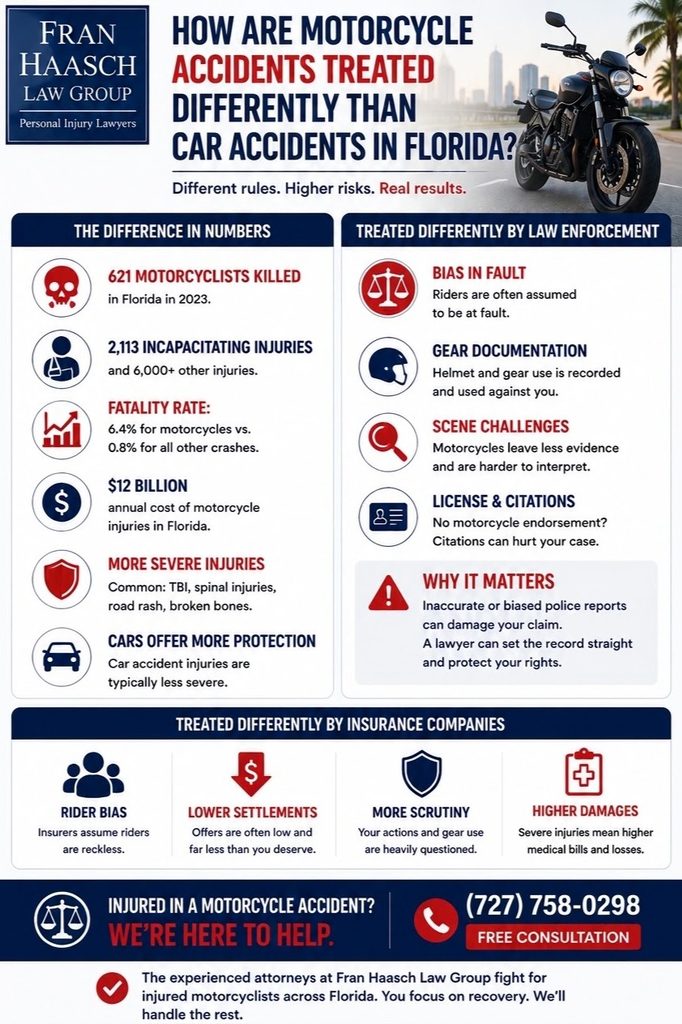
- Florida reported 9,548 motorcycle crashes in 2023, resulting in 621 fatalities. In that same year, 2,113 riders suffered incapacitating injuries, and more than 6,000 others sustained less severe injuries. These numbers place Florida at the top of the nation for motorcycle deaths.
- The fatality rate for motorcycle crashes is dramatically higher than for car accidents. In 2022, Florida’s motorcycle crash fatality rate was 6.4%, compared to just 0.8% for all other traffic crashes in the state combined.
- Motorcyclists are far more likely to be killed or seriously hurt. Nationally, motorcyclists made up approximately 15% of all traffic fatalities in 2023, despite being a fraction of registered vehicles on the road.
- The cost of motorcycle injuries is staggering. Motorcycle injuries cost Florida an estimated $12 billion annually in medical expenses, emergency response costs, and lost productivity.
- Severe injuries are more common in motorcycle crashes. Without the structural protection of a car body, airbags, and seatbelts, motorcycle riders are far more vulnerable to traumatic brain injuries, spinal cord injuries, road rash, broken bones, and internal organ damage.
- Protective gear reduces but does not eliminate the risk. Helmets reduce the risk of death by 37% for riders and 41% for passengers, according to the Centers for Disease Control and Prevention. However, even riders who wear full protective gear can sustain life-altering injuries in a crash.
- Car accident victims typically face less catastrophic injuries. The enclosed cabin of a car provides substantial protection. Car accident cases more often involve soft tissue injuries, whiplash, and moderate trauma rather than the severe injuries sustained in motorcycle crashes.
These differences matter not only medically but also legally and financially. The injuries sustained in motorcycle accidents typically require longer recoveries, more complex medical care, and higher total costs than injuries in most car accidents.
How Are Motorcycle Accidents Treated Differently Than Car Accidents By Florida Law Enforcement?
When law enforcement responds to a motorcycle accident, there are several ways the investigation and documentation process can differ from a typical car accident scene.
Bias in Fault Determination
Officers are human, and studies have found that motorcyclists are often presumed to have been riding recklessly even before an investigation is complete. If an officer arrives with a preconceived assumption that the rider was speeding or weaving, that bias can shape how the crash report is written, which affects your motorcycle accident claim.
Helmet and Protective Gear Documentation
Florida law allows riders over 21 to ride without a helmet if they carry at least $10,000 in medical insurance coverage. However, law enforcement reports will typically document whether a rider was wearing a helmet and what protective gear was in use at the time of the crash. Insurance companies will use this information to argue that the rider’s injuries were worsened by their own choices.
Scene Reconstruction Challenges
Motorcycles leave different physical evidence at a crash scene than cars. A bike may travel farther after impact, there may be less visible property damage, and debris patterns can be harder to interpret. If officers are less experienced with motorcycle crash reconstruction, important details can be missed or documented incorrectly in the police report.
Criminal Charges and Licensing Issues
Florida requires a motorcycle endorsement on a standard driver’s license to legally operate a motorcycle. If a rider was unlicensed or lacked the proper endorsement at the time of the crash, law enforcement may issue citations that complicate the legal picture. Roughly 36% of Florida motorcycle accidents resulting in fatalities involve riders without a valid motorcycle license.
What This Means for Your Case
A police report with inaccurate or biased information can seriously damage your motorcycle accident case. An experienced motorcycle accident lawyer can review the report, gather additional evidence, identify witnesses, and work with accident reconstruction experts to challenge any findings that do not accurately reflect what happened.
How Do Insurance Companies Handle Motorcycle Accidents Differently Than Car Accidents?
The differences do not stop with law enforcement. Insurance companies approach Florida motorcycle accident cases very differently from car accident claims, and those differences rarely work in the rider’s favor.
Motorcycles Are Excluded From Florida’s PIP System
This is one of the most important distinctions in Florida law. Florida’s no-fault law requires owners of four-wheeled motor vehicles to carry $10,000 in Personal Injury Protection (PIP) coverage, which pays medical expenses regardless of fault. in medical coverage that pays out regardless of fault. Under Florida Statute 627.736, motorcycles are specifically excluded from the PIP requirement.
This means injured riders cannot carry personal injury protection on their motorcycle policy. There is no automatic first-party coverage to pay your medical bills immediately after a crash. Instead, motorcycle riders must rely on the at-fault driver’s liability insurance, their own health insurance, optional motorcycle insurance coverage they may have purchased, or ultimately a personal injury lawsuit.
No “Serious Injury” Threshold Required to Sue
Car accident cases in Florida require victims to meet a “serious injury” threshold before they can sue for pain and suffering. That same threshold does not apply to motorcycle accident cases. Injured riders can file a claim directly against the at-fault driver for all damages, including pain and suffering, without having to clear that additional legal hurdle. While this can be an advantage, it also means motorcycle claims move faster and require earlier preparation.
Insurance Adjusters Apply Bias Against Riders
Insurance adjusters handling motorcycle claims often operate under the assumption that the rider was partially or fully at fault. They may claim the rider was speeding, lane-splitting, or otherwise riding irresponsibly. These tactics are designed to reduce the payout or deny the claim entirely. Even when the other driver was clearly negligent, adjusters will dig for any reason to minimize motorcycle accident claims.
The “Helmet Defense” and Comparative Negligence
Florida follows a modified comparative negligence rule. If you are found to be more than 50% at fault for your own injuries, you cannot recover compensation. Insurance companies aggressively try to assign fault to injured riders, including by arguing that not wearing a helmet or certain protective gear contributed to the severity of injuries. This can reduce or eliminate compensation for medical expenses and other damages.
Underinsured and Uninsured Motorist Coverage Gaps
Many Florida drivers carry only the minimum required property damage liability coverage and no bodily injury liability insurance at all. For car accident victims, PIP provides some protection in this situation. For motorcycle riders who do not carry personal injury protection, an uninsured or underinsured driver can mean there is simply no coverage to pursue without additional insurance options in place.
Medical Insurance Coverage Complications
Because PIP does not apply to motorcycle crashes, injured riders who use their medical insurance coverage may find that their health insurer asserts a lien against any eventual settlement. Navigating those lien negotiations while simultaneously fighting an at-fault driver’s insurance company requires legal experience specific to Florida motorcycle accident cases.
How Will Fran Haasch Law Group Car Accident & Personal Injury Lawyers Help Me?
If you have been injured in a Florida motorcycle accident, you are already dealing with enough. Your focus should be on recovery, not on fighting insurance companies. At Fran Haasch Law Group Car Accident & Personal Injury Lawyers, we handle the legal battle so you do not have to.
Our team understands the unique challenges that come with Florida motorcycle accident cases. We know how insurance adjusters think, what arguments they will make, and how to counter them with strong evidence. From gathering the accident report and crash scene evidence to working with medical experts who can document the full extent of your traumatic brain injuries, spinal cord injuries, or other severe injuries, we build the kind of case that gets results.
We work with injured riders who are facing serious injuries, overwhelming medical expenses, time away from work, and a future that may look very different than it did before the crash. We fight to recover compensation for all of it, including past and future medical bills, lost income, pain and suffering, and more.
The insurance companies count on injured riders not knowing their rights. They count on victims accepting lowball offers out of desperation. We make sure that does not happen.
If you or a family member was hurt in a motorcycle crash anywhere in Florida, contact Fran Haasch Law Group Car Accident & Personal Injury Lawyers today to schedule a free consultation. There is no fee unless we win your case.