








Is Lane Splitting Legal in Florida?
Motorcycles have a distinct physical advantage over larger motor vehicles: their narrow profile allows riders to maneuver between cars and move through congested traffic faster than other vehicles on the road. In stop-and-go conditions, some motorcycle riders take full advantage of this by riding between lanes, a practice commonly known as lane splitting. While many motorcyclists argue the maneuver is safer than sitting between two lanes of slow-moving vehicles, drivers of cars and trucks often see it as unpredictable and dangerous. This ongoing debate has led some states to formally legalize the practice, while others continue to prohibit it. So where does Florida stand? In Florida, it is illegal to lane-split. But read on for a clear look at what Florida law actually says about motorcycle lane splitting, the penalties involved, and what it means for anyone hurt in a motorcycle accident.
What Is Lane Splitting?
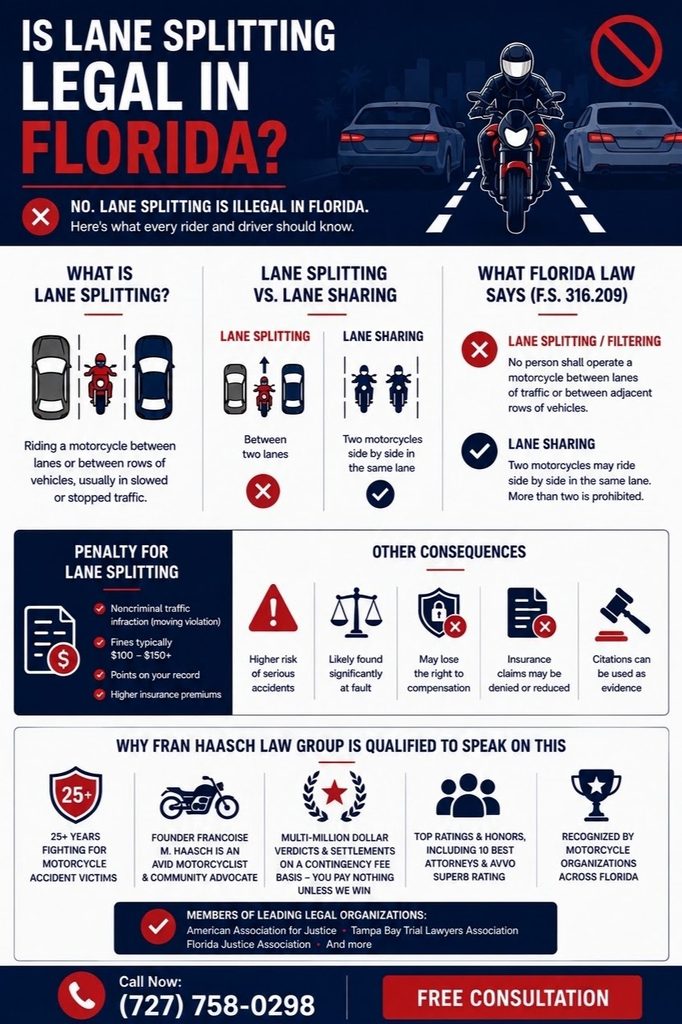
Lane splitting is when a motorcycle rider drives between two lanes of traffic or between adjacent lines of vehicles, usually during slowed traffic or at a complete stop. Instead of waiting in line behind other vehicles, the motorcyclist rides along the lane-dividing line, effectively using the space between two rows of cars as a travel path. The practice is also referred to as “white lining” or “striping,” named for the painted lines the rider travels along. Some riders do this at low speeds in heavy congestion, while others do it at highway speeds, which significantly increases the danger involved. Lane filtering is closely related and is often used interchangeably with lane splitting, though it typically refers specifically to moving through stopped or very slow traffic, such as at a red light.
Lane Splitting vs. Lane Sharing
Lane sharing is a different practice that is often confused with lane splitting. Lane sharing occurs when two motorcycles ride side by side within the same lane, rather than between two lanes. This is common when riders travel together in groups. Lane sharing keeps both motorcyclists within the boundaries of one lane, unlike lane splitting, which involves crossing between two separate lanes of traffic. The distinction matters legally because Florida treats the two practices very differently.
What Are the Florida Laws on Lane Splitting and Lane Sharing?
Florida Statute 316.209 governs how motorcycle riders may use lanes on Florida roads. The statute addresses both lane splitting and lane sharing, and the rules for each are clear.
Lane Splitting and Lane Filtering
Florida Statute 316.209(3) states: “No person shall operate a motorcycle between lanes of traffic or between adjacent lines or rows of vehicles.” This language covers both lane splitting and lane filtering. Florida law does not distinguish between the two. Whether traffic is moving or stopped, a motorcyclist is prohibited from riding between lanes or rows of vehicles. Both practices are treated as the same violation under Florida traffic laws.
Lane Sharing
Florida Statute 316.209(4) permits lane sharing with limitations. Two motorcycles may legally ride side by side within a single lane. However, operating more than two motorcycles abreast in a single lane is prohibited. The law recognizes that a standard lane is wide enough for two motorcycles to share safely, but that three or more create serious hazards for everyone involved.
White Lining
Florida considers “white lining” to be the same as lane splitting. The term refers to a motorcyclist riding along the painted lines between lanes of traffic. Regardless of the name used, riding between adjacent lines or rows of vehicles violates Florida Statute 316.209(3) and is treated identically to any other form of lane splitting under state law.
What Is the Penalty for Lane Splitting in Florida?
Under Florida law, lane splitting is classified as a noncriminal traffic infraction and is punishable as a moving violation. Motorcyclists caught lane-splitting can be issued a traffic citation by police. Fines vary by county but typically range from $100 to $150 or more. In addition to the fine, a moving violation adds points to the rider’s driving record, which can lead to higher insurance premiums. The violation is not a criminal offense, but its consequences can extend well beyond the initial citation, particularly if an accident occurs.
Other Consequences of Lane Splitting
Beyond the traffic citation itself, lane-splitting motorcycle riders face a range of additional consequences that can affect their safety, finances, and legal standing:
- Increased accident risk. Lane-splitting accidents are more likely to occur because drivers do not expect a motorcycle to appear between lanes. Limited space, reduced reaction time, and blind spots all contribute to a higher chance of a collision when a rider is splitting lanes.
- Significant fault in a collision. Because lane splitting is illegal in Florida, a motorcyclist who is involved in a lane-splitting accident will likely be assigned a significant portion of the fault. Under Florida’s comparative negligence system, this directly reduces the amount of compensation they can recover.
- Potential loss of compensation entirely. Under Florida Statute 768.81, any injured party found to be more than 50 percent at fault cannot recover damages from other parties. A motorcyclist who was splitting lanes at the time of an accident could be barred from recovering anything at all, even if the other driver was also negligent.
- Insurance claim denials or reductions. Insurance companies routinely use evidence of lane splitting to deny or reduce motorcycle accident claims, arguing that the rider’s illegal actions contributed to the crash.
- The traffic citation as evidence. A citation for a moving violation related to lane splitting can be used as evidence of negligence in a personal injury case, making it harder to argue that another driver was primarily responsible.
What Makes Fran Haasch Law Group Accident & Injury Lawyers Qualified to Provide Information About Lane Splitting in Florida?
Fran Haasch Law Group Accident & Injury Lawyers has been representing motorcycle accident victims across Florida for more than 25 years. The firm’s founding attorney, Francoise M. Haasch, is an avid motorcyclist herself and has been a recognized presence in the Tampa Bay biker community for decades, providing legal guidance at motorcycle events and rallies throughout the region. That firsthand connection to the motorcycle community gives the firm a practical understanding of the real-world situations riders face on Florida roads.
On the professional side, the firm’s qualifications in handling motorcycle accident claims are extensive. Attorney Fran Haasch is a Lifetime Member of the Multi-million Dollar Advocates Forum and a member of the Elite Lawyers of America, a designation reserved for civil trial attorneys who have obtained verdicts or settlements of at least $2 million. She holds a Superb Rating from Avvo and has been recognized by the American Institute of Personal Injury Attorneys as one of the 10 Best Attorneys for exceptional client service. In 2025, she received the Florida Justice Association’s James F. “Jim” McKenzie From Day One Award, which recognizes attorneys who have demonstrated a long-term commitment to defending Florida’s civil justice system. Haasch is also a member of the American Association for Justice and the Tampa Bay Trial Lawyers Association.
The firm has received Appreciation Awards from the Latin American Motorcycle Association (LAMA) chapters in multiple cities and has been recognized by Shakes, Rattles, Rides and Rods, reflecting its deep ties to Florida’s riding community. Attorneys Joshua R. Lipton and David Fuller are members of the Florida Justice Association and the Tampa Bay Trial Lawyers Association. The team has secured multimillion-dollar verdicts and settlements for motorcycle accident clients and handles cases on a contingency fee basis, meaning clients pay nothing unless the firm wins their case. When it comes to understanding how Florida traffic laws affect motorcycle riders and how lane splitting can impact a motorcycle accident claim, Fran Haasch Law Group brings both the legal credentials and the community knowledge to speak with authority on the subject.